The Golden Letter: The Complete Guide for Real Estate Agents
Every agent has heard some version of the claim: a one-sentence letter, mailed to the right homes, that makes sellers call you. That letter has a name, the golden letter, and unlike most real estate marketing folklore, the numbers behind it are public, repeatable, and unusually well documented.
This guide covers what the golden letter actually is, the exact format that works, the published response math, how to pick targets, how often to mail, what to say when the phone rings, and the one structural flaw in the classic version that you should know about before you send a single envelope. The homeowner replies you'll see below are real ones, from letters we mailed.
What is the golden letter?
The golden letter is a short, plain letter to a homeowner asking one question: would you sell your home to a buyer my client is working with? No branding. No market report. No glossy anything. It reads like a personal note because that is exactly what it looks like in the mailbox: typed on plain paper, folded into a plain envelope, with a real stamp.
The best-known practitioner is Will Van Wickler, a Maine agent who built a seven-figure solo business in his early twenties largely on this letter, and who has walked through his system in detail on industry podcasts. The format traces back decades through Keller Williams training circles before he popularized it. His core message about the letter, repeated in every interview: stop changing it. The plainness is the mechanism.
The exact format (and why every "improvement" backfires)
- One question, a few sentences. Would you consider selling your home at [address] to my buyer? Call me.
- Plain 8.5x11 paper, typed, folded, plain envelope. No letterhead, no logo, no headshot.
- A real stamp. Metered mail reads as marketing before it's even opened.
- No return address. Nothing on the envelope competes with "this looks personal."
- The compliance line: if your home is currently listed, this is not a solicitation. Non-negotiable.
- A phone number that can catch the call, ideally a dedicated tracking number per mail area, so you know which neighborhood produced which lead.
Everything agents instinctively want to add, a headshot, a brokerage logo, "we have 3 buyers!", production values, converts the letter from personal correspondence into recognizable marketing, and response drops. A 20-year veteran who mentored Van Wickler put the psychology simply: it works because it's about the homeowner, not the agent. A question addressed to you personally is very hard to throw away unanswered.
The numbers: what 1,000 letters actually produces
Van Wickler's published funnel, consistent across multiple interviews, looks like this in a normal market:
| Stage | Per 1,000 letters |
|---|---|
| Calls and texts from homeowners | 10 to 15 |
| Listing appointments | 2 to 3 |
| Signed listings that sell | about 1 |
A 1 percent response is the working floor; high-turnover areas do better, trophy price points do worse. The economics are what make agents stay with it: at typical commissions, one listing pays for a year of mailing many times over. His most quoted comparison is the cost per seller lead, roughly $100 per seller conversation at those rates, against portal buyer leads that cost many hundreds or thousands each, shared with other agents.
Our own campaigns run above that floor. Two recent buyer-letter campaigns we mailed replied at 2.9 percent and 3.7 percent of delivered pieces, roughly three times the published 1 percent benchmark for the classic version.
An honest caveat, because numbers like that deserve one: those are different markets and different lists than the published benchmark, so this is not a controlled head-to-head test. What we can say is that in our campaigns, a letter naming a real buyer with a real budget has consistently out-replied the 1 percent floor, and the reason is not hard to guess. The classic letter has to survive the question "is this buyer real?" Ours answers it.
A real homeowner reply
This is a text a homeowner sent after one of my letters landed. He photographed the letter itself, and opened the negotiation in his second message. His number is blurred for privacy.
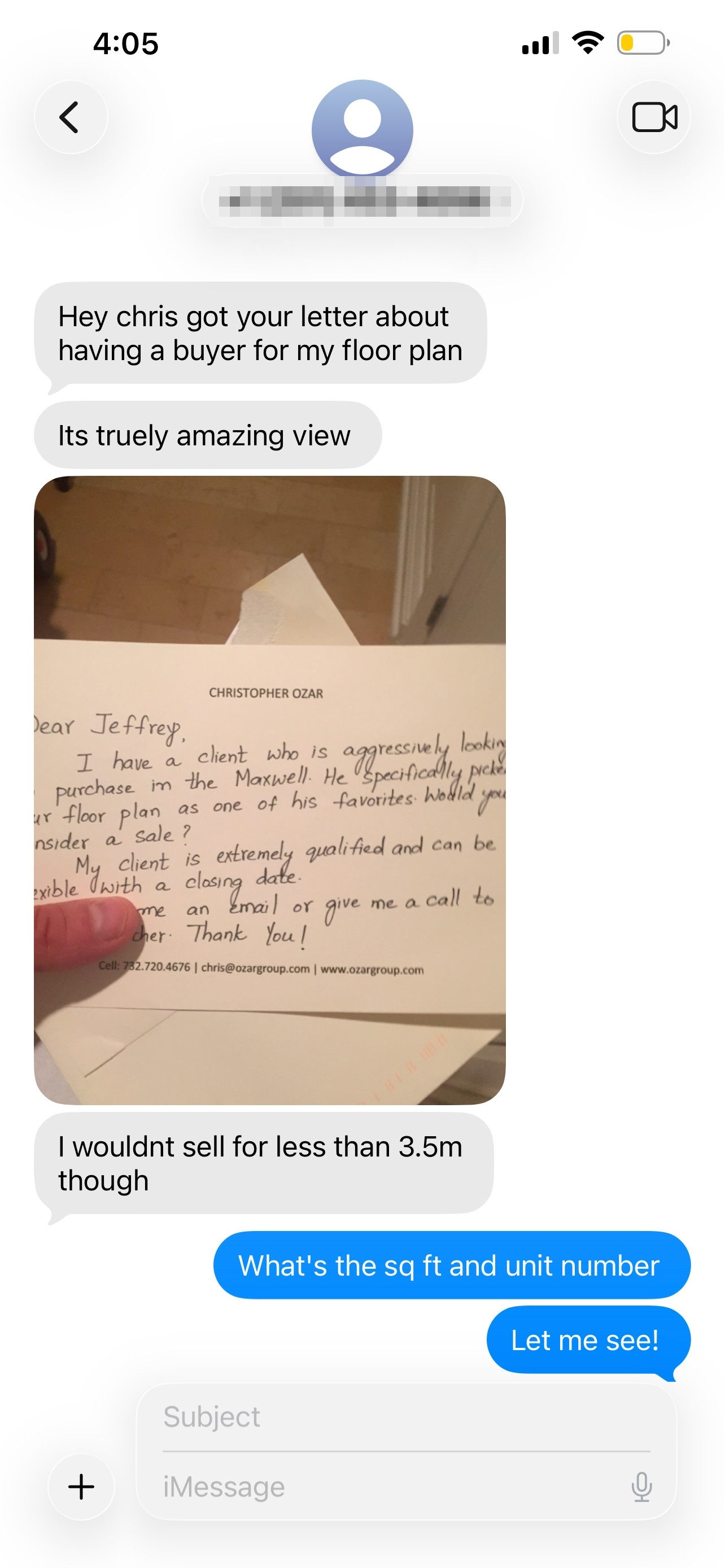
Look at what happened there: an unlisted owner of a multimillion-dollar condo photographed the letter, texted the agent first, and named his price, all from one piece of mail. The letter doesn't generate "leads" in the internet sense; it generates owners of unlisted homes starting a selling conversation with one agent.
Targeting: where golden letters work best
- High-turnover neighborhoods at healthy price points. The simplest research method is the one Van Wickler describes: look at closed sales on a map and find where the activity clusters.
- Owners 3 to 7 years into ownership. That window is when move consideration naturally peaks.
- Absentee and second-home owners. His signature niche: they never need to meet you before the sale conversation, the "where would I go?" objection doesn't exist, and they tend to be numbers-driven sellers.
- Solid equity positions. Owners who can transact.
- Layered lists for advanced users: expireds, pre-foreclosure with high equity, land and teardowns for builder clients.
Cadence: the frequency paradox
The one way to break a golden letter is to send it too often. A buyer letter arriving every month tells the homeowner the buyer isn't real. The same home should hear from you every 8 to 12 months, not more. Between rounds, the credibility compounds instead of eroding.
Practical rhythm: start with about 500 letters per month and commit to six months. Response builds over a 90-day curve, and consistency beats bursts. The agents who fail with this system are almost always the ones who stop after one round.
When the phone rings
Calls arrive in four flavors: ready sellers ("when can you come by?"), remove-me requests, price-fishers ("what would your buyer pay?"), and the genuinely curious. Two rules cover most of it:
- Never quote a price on the phone. The appointment is where numbers happen: do the homework, bring a real market figure, and let the seller decide with full information.
- Book the appointment within 24 hours of the callback. Momentum is the whole game with inbound sellers.
The flaw in the classic version, and the honest fix
Here is the part most golden letter articles skip. The classic letter implies a buyer. When the homeowner asks the obvious question, "is this buyer real?", the classic system answers with confidence and reframes. That worked for years, but it is the letter's structural weak point, and in the post-2024 world of tightened buyer representation rules, an implied buyer is a liability an agent shouldn't carry.
The fix is simple: run the letter with a real one. Our version of the system mails on behalf of an actual captured buyer inquiry, a named buyer, with an area and budget, that the homeowner's agent can verify. The letter survives the "is this real?" question at the mailbox, on the phone, and at the kitchen table, because the answer is yes. Same envelope psychology, none of the bluff.
DIY vs done-for-you
You can absolutely run golden letters yourself: the materials cost under a dollar a letter, and 30 minutes a day of printing, folding, and stuffing produces roughly 500 a month. What the DIY route really costs is the system around the letter: the list-building, the suppression of active listings and recent sales, the per-area tracking numbers, the cadence discipline, and the hours. Van Wickler himself runs it with a production helper and dedicated tracking lines. If you'd rather own the territory and skip the paper cuts, that machine is what we built.
Want golden letters without the assembly line?
Handwritten-style letters, mailed for you every month, tied to a real captured buyer, in a territory that is yours alone. One agent per territory.
See how it worksOr book a call and we'll look at your market together.
FAQ
What response rate should I expect?
Plan on 1 percent as a floor: 10 to 15 conversations per 1,000 letters in a normal market. High-turnover areas can do multiples of that; our best recent batch replied at 2.9 percent.
How much do golden letters cost?
DIY costs you the materials plus your time. A done-for-you service prices by territory size, and covers the list building, suppression of active listings, printing, postage, and reply tracking.
How is this different from postcards?
Postcards are recognizable marketing and get processed as such. A plain personal letter gets opened and answered. Direct mail industry stats consistently show letter formats outperforming glossy formats on response, and our own reply rates bear it out.
Is it compliant?
Yes, with two rules: include the not-a-solicitation line for listed homes, and never claim a buyer you don't have. The safest version names a real, verifiable one.
Sources: Will Van Wickler's public interviews on the Listing Beast and MREA podcasts and Keller Williams trainings, industry direct-mail response studies, and MailboxListings campaign data. We have no affiliation with Mr. Van Wickler; his numbers are cited from his own published accounts.